Unlock 10% OFF instantly with code WELCOME10




Description
Product Description
Chemistry Advent Calendar 2026 – Science Christmas Countdown | STEM Gift for Chemistry Lovers
Celebrate the magic of science and the excitement of Christmas with the Chemistry Advent Calendar 2026 – Science Christmas Countdown | STEM Gift for Chemistry Lovers.
Inspired by the fascinating world of chemistry, scientific discovery, and laboratory exploration, this unique holiday countdown brings a science-themed twist to traditional Christmas celebrations.
Chemistry is the science of matter, its properties, composition, structure, and the transformations that occur through chemical reactions.
From the elements that make up the periodic table to the molecules found in everyday life, chemistry helps explain how the world works.
The Chemistry Advent Calendar celebrates this fascinating subject through a Christmas countdown concept inspired by scientific curiosity, laboratory imagery, and the excitement of discovery.
For students, chemistry represents an opportunity to explore the building blocks of matter and understand the processes that shape the natural world.
For teachers, it is a subject filled with opportunities to encourage curiosity, observation, and critical thinking.
For scientists and laboratory professionals, chemistry is a field that connects theoretical understanding with practical applications.
The Chemistry Advent Calendar 2026 brings these interests into the festive season through a playful science-inspired holiday experience.
Unlike conventional Christmas gifts, a chemistry-themed Advent Calendar celebrates the intellectual curiosity and creativity associated with scientific exploration.
Its distinctive theme makes it particularly appealing to chemistry enthusiasts, STEM students, science educators, laboratory professionals, and people who appreciate educational collectibles.
The Christmas countdown format adds anticipation throughout the holiday season while celebrating the beauty and complexity of scientific discovery.
Whether you're shopping for a chemistry teacher, science student, laboratory researcher, or someone who simply loves the periodic table, this Advent Calendar offers a thoughtful seasonal gift idea.
Make Christmas 2026 a celebration of curiosity, learning, scientific creativity, and the wonders of chemistry.
Discover the Chemistry Advent Calendar 2026 – Science Christmas Countdown | STEM Gift for Chemistry Lovers Today!
The Story Behind the Design
The inspiration behind the Chemistry Advent Calendar begins with humanity's longstanding curiosity about the nature of matter.
For thousands of years, people have explored the materials around them and attempted to understand how substances change.
Early civilizations developed practical knowledge of metallurgy, ceramics, dyes, glassmaking, and other chemical processes.
These discoveries helped establish foundations for later scientific investigation.
Ancient Greek philosophers proposed different explanations for the composition of matter.
Democritus is often associated with an early philosophical concept of atoms.
However, modern atomic theory developed much later through scientific experimentation.
During the medieval and early modern periods, alchemy contributed techniques and equipment that influenced the development of chemistry.
Alchemists explored substances, transformations, and laboratory methods.
Although many alchemical theories were not scientifically valid, some practical techniques became important in later chemical research.
The scientific revolution encouraged more systematic experimentation and measurement.
Robert Boyle became an important figure in the development of modern chemistry.
His work emphasized experimental investigation and the study of chemical substances.
Antoine Lavoisier later helped establish the law of conservation of mass in chemical reactions.
His contributions to chemical nomenclature and quantitative experimentation played a major role in the development of the discipline.
John Dalton introduced an influential modern atomic theory in the early nineteenth century.
His work helped explain how elements combine in chemical compounds.
The study of chemical elements continued expanding as scientists identified and characterized new substances.
In 1869, Dmitri Mendeleev published an influential arrangement of the periodic table.
His organization of the elements helped reveal recurring patterns in their properties.
The periodic table became one of the most recognizable symbols of chemistry.
Its structure reflects relationships between chemical elements and their atomic characteristics.
Modern chemistry recognizes 118 confirmed chemical elements.
These elements form the foundation of the substances found throughout the natural world.
Hydrogen is the lightest chemical element and the most abundant element in the universe.
Oxygen is essential to many biological and chemical processes.
Carbon plays a central role in organic chemistry and the molecular structures of living organisms.
Iron is important in metallurgy, engineering, and biological systems.
Gold is valued for its distinctive physical and chemical properties.
The study of elements provides insight into how matter behaves under different conditions.
Chemical bonding explains how atoms combine to form molecules and other structures.
Covalent bonds involve the sharing of electrons between atoms.
Ionic bonding involves electrostatic attraction between oppositely charged ions.
Molecular structures influence the physical and chemical properties of substances.
Water, represented by the formula H₂O, is one of the most familiar chemical compounds.
Its molecular properties contribute to its importance in biological and environmental systems.
Carbon dioxide, represented by CO₂, plays important roles in atmospheric chemistry and the global carbon cycle.
Acids and bases are another important area of chemical study.
The pH scale helps describe the acidity or basicity of aqueous solutions.
Chemical reactions can involve changes in temperature, color, gas formation, or the production of new substances.
Scientists use laboratory equipment to observe and investigate these processes.
Beakers are commonly used for holding, mixing, and heating liquids.
Erlenmeyer flasks are recognizable laboratory vessels with conical bodies and narrow necks.
Test tubes are used for handling small quantities of substances.
Graduated cylinders are designed for measuring liquid volumes.
Pipettes help transfer controlled quantities of liquids.
Safety goggles, gloves, and laboratory coats are important components of laboratory safety when appropriate to the activity.
Chemistry laboratories use careful procedures to reduce risks and improve experimental reliability.
Scientific investigation depends on observation, measurement, testing, and the evaluation of evidence.
Chemistry also connects closely with physics, biology, medicine, engineering, and environmental science.
Biochemistry explores chemical processes within living organisms.
Organic chemistry focuses primarily on carbon-containing compounds.
Inorganic chemistry studies a broad range of substances outside the traditional scope of organic chemistry.
Analytical chemistry develops methods for identifying and measuring chemical substances.
Physical chemistry examines the physical principles underlying chemical systems.
Environmental chemistry investigates chemical processes in air, water, soil, and natural environments.
Materials chemistry contributes to the development of polymers, batteries, semiconductors, and other technologies.
Chemistry education helps students understand scientific principles while developing analytical thinking.
STEM education emphasizes connections between science, technology, engineering, and mathematics.
Science-themed gifts can encourage interest in these subjects and celebrate the enjoyment of learning.
The Advent Calendar tradition provides a familiar way to combine curiosity with seasonal anticipation.
Advent Calendars became popular as a method of counting down toward Christmas.
Modern versions now feature themes ranging from entertainment and hobbies to education and collectibles.
A chemistry-themed Advent Calendar combines this festive tradition with recognizable scientific imagery.
Periodic table designs, molecular structures, laboratory glassware, and chemistry symbols can inspire the visual identity of science-themed products.
The Chemistry Advent Calendar 2026 celebrates scientific curiosity and the enjoyment of discovery through a Christmas countdown concept.
Meaning & Symbolism
Chemistry symbolizes curiosity, discovery, experimentation, and the search for scientific understanding.
The periodic table represents the organization of chemical elements and the relationships between their properties.
Atoms symbolize the fundamental building blocks of ordinary matter.
Molecules represent the connections between atoms and the complexity of chemical structures.
Chemical bonds symbolize interaction, connection, and the formation of new substances.
Beakers represent laboratory experimentation and practical scientific investigation.
Test tubes symbolize observation, testing, and the exploration of chemical reactions.
Erlenmeyer flasks represent the recognizable visual identity of chemistry laboratories.
Molecular models symbolize the three-dimensional structures that influence chemical behavior.
Chemical formulas represent the scientific language used to describe substances.
The pH scale symbolizes measurement and the study of acids and bases.
Laboratory safety equipment represents responsibility and careful scientific practice.
STEM education symbolizes interdisciplinary learning, creativity, and problem-solving.
Scientific discovery represents the ongoing process of questioning, testing, and refining knowledge.
The Christmas countdown symbolizes anticipation, celebration, and the enjoyment of festive traditions.
Ultimately, the Chemistry Advent Calendar celebrates science, curiosity, creativity, learning, and the excitement of Christmas.
🧪 Product Description
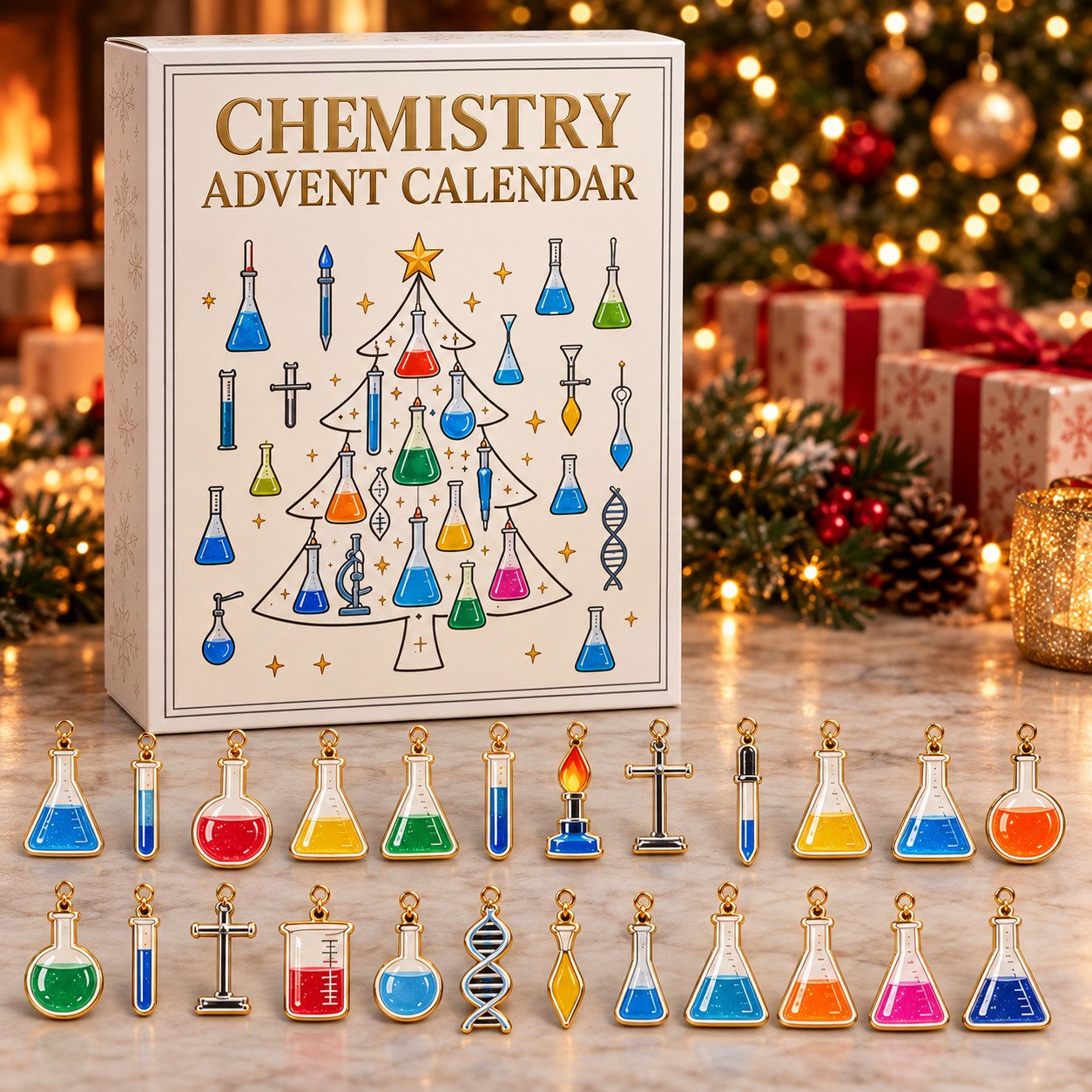
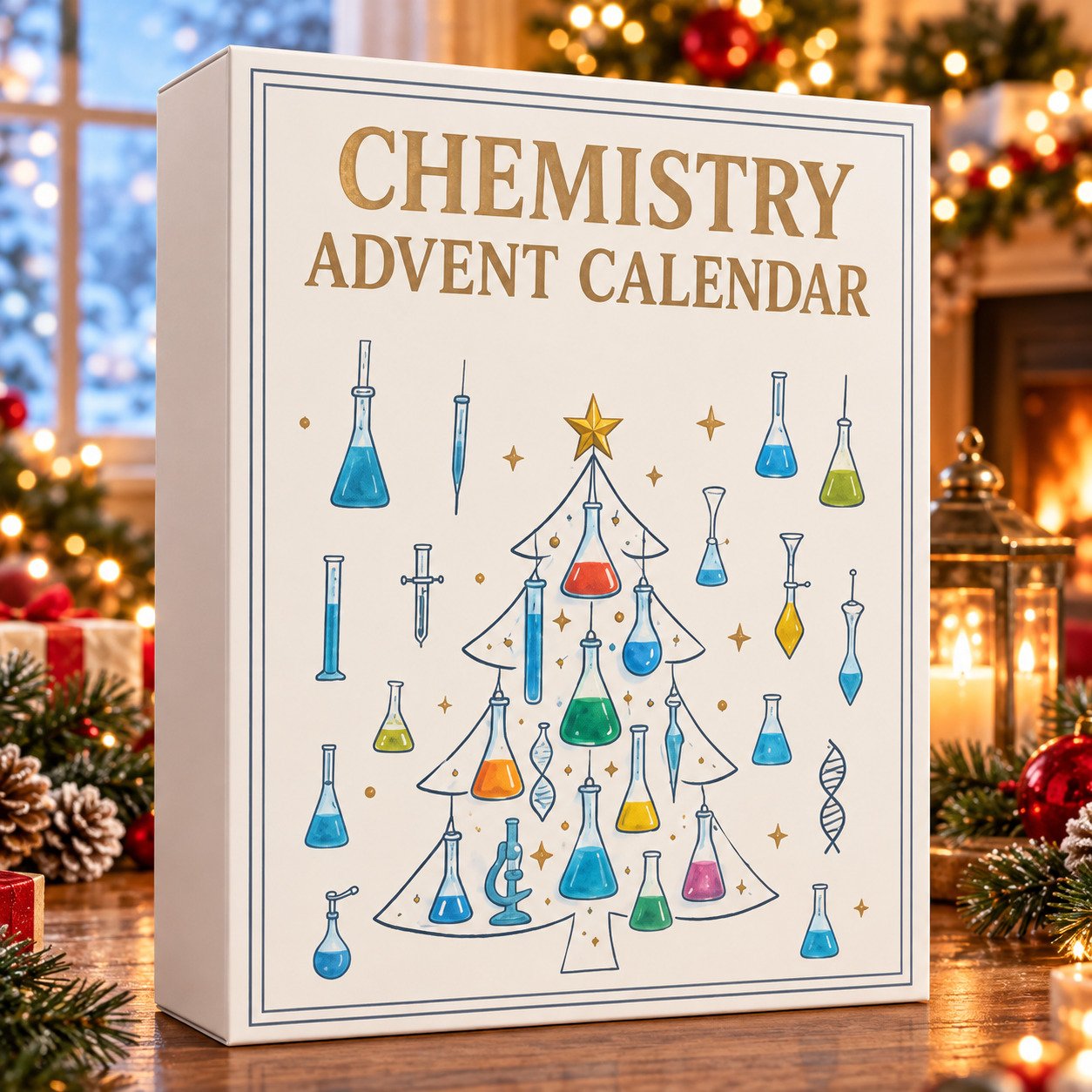
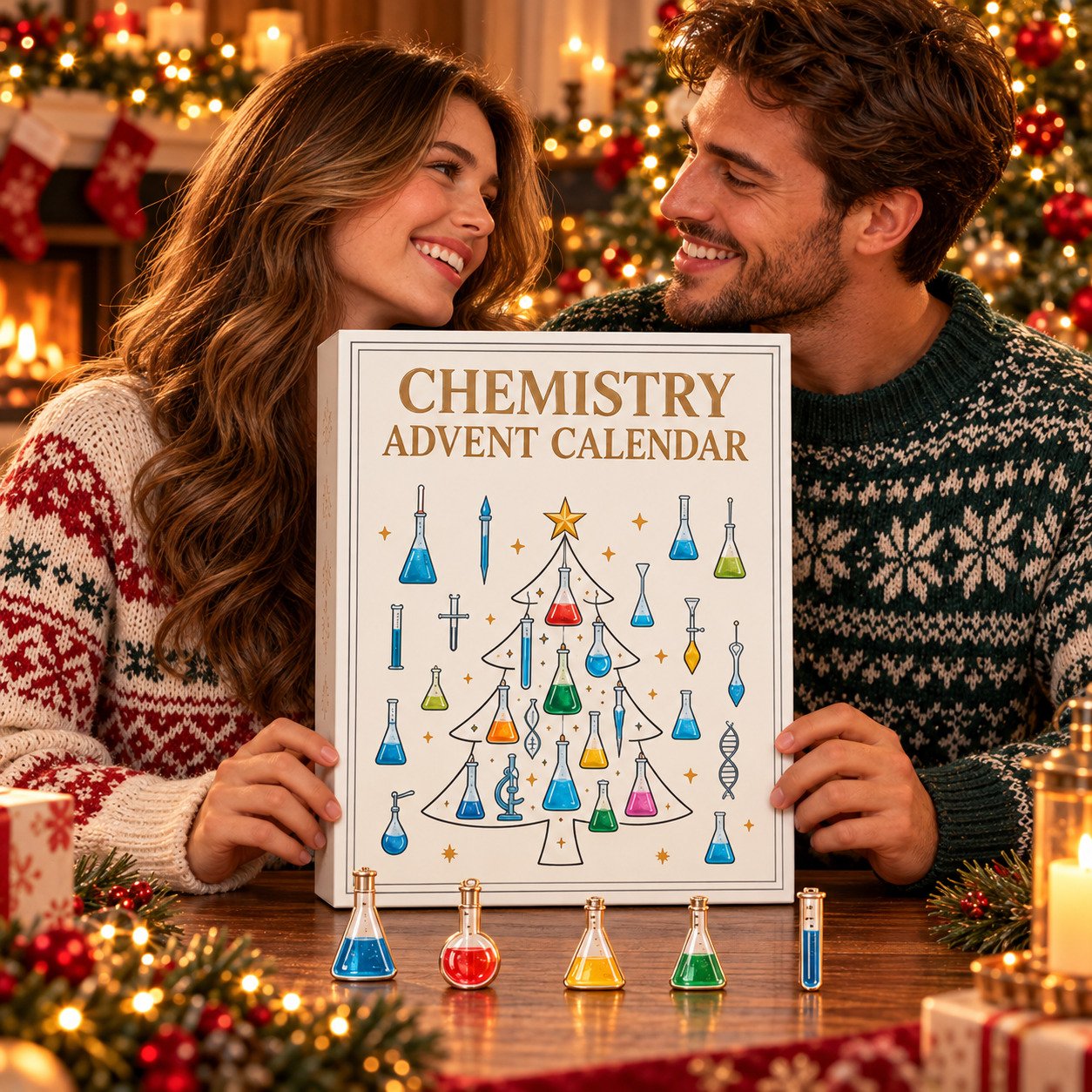
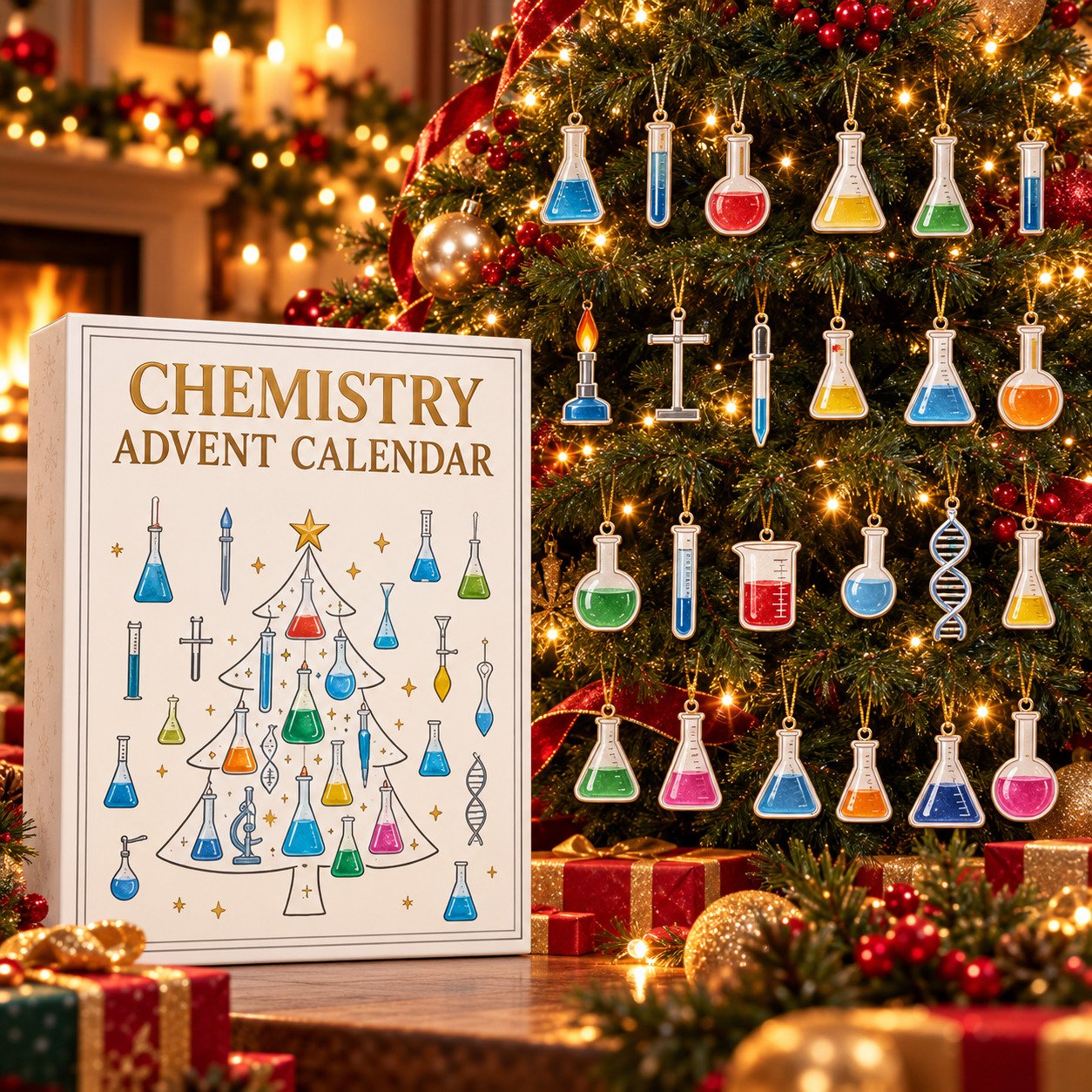
The Chemistry Advent Calendar 2026 is a science-themed Christmas countdown inspired by the fascinating world of chemistry and laboratory exploration.
Its distinctive theme combines festive anticipation with recognizable scientific concepts, chemistry-inspired imagery, and the enjoyment of discovery.
For chemistry students, the calendar offers a seasonal connection to a subject filled with fascinating elements, molecules, and chemical reactions.
For science teachers, it provides a Christmas gift concept that celebrates education, curiosity, and the importance of scientific learning.
For laboratory professionals, the theme reflects an appreciation for scientific investigation and the recognizable aesthetic of chemistry laboratories.
The countdown concept makes it an appealing option for people who enjoy STEM-themed gifts and educational collectibles.
Its science-inspired identity distinguishes it from conventional Christmas calendars.
Depending on the actual design, the calendar may complement a study desk, classroom, science-themed display, or holiday decoration arrangement.
As a Christmas gift, it offers a thoughtful option for chemistry teachers, science students, researchers, and people who enjoy the periodic table.
The calendar's theme celebrates chemistry as a scientific discipline without implying that it necessarily includes functional experiments or chemical substances.
The exact number and type of included surprises, materials, dimensions, and any recommended age range should be confirmed against the actual product specifications.
Whether purchased for personal enjoyment or given to a fellow science enthusiast, the Chemistry Advent Calendar 2026 celebrates curiosity, scientific creativity, and festive anticipation.
🔧 Product Features
-
Product Name: Chemistry Advent Calendar 2026.
-
Product Type: Science-themed Christmas Advent Calendar.
-
Year: 2026.
-
Primary Theme: Chemistry and scientific discovery.
-
Design Inspiration: Laboratory equipment, periodic table elements, molecules, and chemical symbols.
-
Educational Theme: Scientific curiosity, chemistry concepts, and STEM appreciation.
-
Holiday Experience: Chemistry-themed Christmas countdown.
-
Science Inspiration: Atomic structures, chemical compounds, laboratory exploration, and scientific experimentation.
-
Collector Appeal: Seasonal gift concept for science-themed collectible enthusiasts.
-
Classroom Connection: A chemistry-inspired holiday theme for students and educators.
-
STEM Appeal: Celebrates science, technology, engineering, and mathematics.
-
Display Appeal: Suitable for science-themed holiday presentation, depending on the actual product design.
-
Christmas Theme: Festive anticipation and seasonal discovery.
-
Intended Audience: Chemistry lovers, science students, teachers, researchers, and STEM enthusiasts.
-
Gift Occasions: Christmas, Secret Santa, science club celebrations, and holiday gift exchanges.
-
Emotional Appeal: Celebrates curiosity, creativity, learning, and the excitement of scientific discovery.
🚚 Shipping & Fulfillment
We pride ourselves on reliable fulfillment and clear timelines.
-
Processing time: 3–5 business days (made-to-order, where applicable).
-
Shipping time: 7–15 business days depending on location.
-
Tracking information is available once your order is dispatched.
Why Choose This Chemistry Advent Calendar?
✅ Celebrate the Wonders of Chemistry: Bring the fascinating world of elements, molecules, and scientific discovery into your Christmas celebrations.
✅ A Thoughtful STEM Christmas Gift: Surprise chemistry students, science teachers, and laboratory enthusiasts with a holiday gift that reflects their interests.
✅ A Unique Science-Themed Countdown: Enjoy festive anticipation with a Christmas calendar inspired by recognizable chemistry concepts and laboratory imagery.
✅ Perfect for Science Enthusiasts: Choose a holiday gift concept that celebrates curiosity, learning, and the enjoyment of scientific exploration.
✅ Make Christmas More Educationally Inspiring: Combine seasonal excitement with appreciation for chemistry, STEM education, and scientific creativity.
Bring the excitement of scientific discovery into the holiday season and make the Chemistry Advent Calendar 2026 – Science Christmas Countdown | STEM Gift for Chemistry Lovers part of your Christmas traditions for a countdown filled with curiosity, creativity, and festive fun.
Shipping
Shipping & Delivery
We strive to provide a smooth and reliable shopping experience with transparent processing and delivery times.
- Processing Time: 3–5 business days (made-to-order production, where applicable).
- Shipping Time: 7–15 business days, depending on the destination.
- Estimated Total Delivery: 10–20 business days after placing your order.
- Order Tracking: Tracking information will be sent via email once your order has been shipped.
Please note that delivery times are estimates and may vary due to customs clearance, carrier delays, holidays, or other unforeseen circumstances.
For shipping-related questions, please contact support@tdcustomapparel.com.
Return & Warranty
Return & Warranty
Your satisfaction is important to us. We are committed to resolving eligible product and order issues fairly and promptly.
- 30-Day Return Request Window: Contact us within 30 days of delivery if your item arrives damaged, defective, incorrect, or materially different from its description.
- Made-to-Order Products: Returns or exchanges for change of mind, incorrect customer-selected sizes, or personal preferences are generally not accepted.
- Replacements & Refunds: Eligible issues may qualify for a replacement, full refund, or another appropriate resolution.
- Refund Processing: Approved refunds are initiated to the original payment method within 5–10 business days.
- Return Shipping: For verified defective, damaged, or incorrect items, we cover reasonable return shipping costs or provide a prepaid label where available.
- Order Assistance: Please contact us with your order number, a description of the issue, and clear photos where applicable.
These terms do not limit any rights provided by applicable consumer protection laws.
For assistance, please email support@tdcustomapparel.com or refer to our Return Policy and Refund Policy.
Related collections
Trending